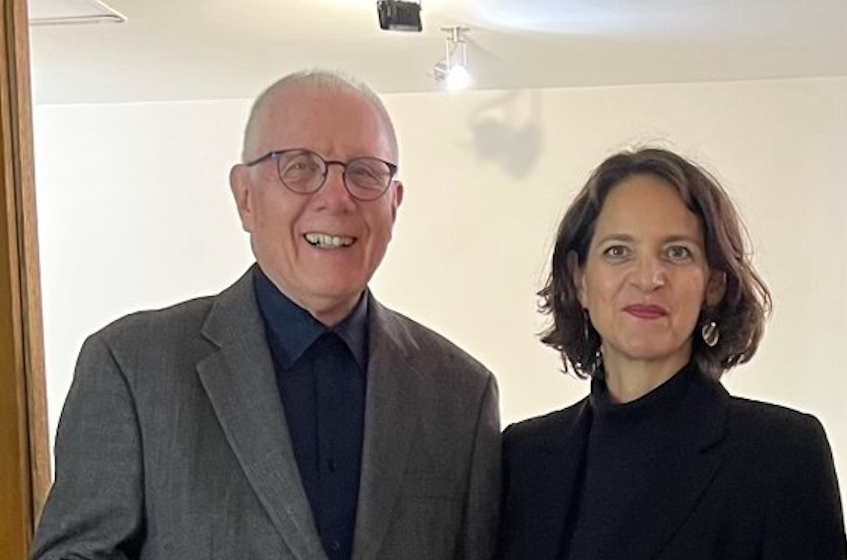
On the Long and Endless Search for Meaning, with Dr. Gindi
Dr. Gindi’s sculptures, so obviously austere but boldly human, are both an asking and a telling. Internationally known for her semi-figurative work, she strives to portray possible states of being as manifested through kindling entanglements in which doubt and desire mesh as main agonists. The depicted characters don’t know to where they are heading. Still, they toil to carve meaning onto their life, notwithstanding long episodes of wooly alienation. They are hard to conceive in that cloudy questing - though aspiring to capture the infinite, knowing that life never ceases to have meaning, they wander around; and around again. Infinity – for Dr. Gindi - is a metonymy for having the courage to prehend the extraordinary, the ethereal, the realm without bound.
A profound disciple of the human condition, Dr. Gindi has a sterling feeling for all those trials and tribulations that detach us from the potential reclamation of infinity. Not many contemporary sculptors have won such universal zeal and precise articulation, besides being informed by such an intellective contexture. There is a softness as well as a bluntness in terms of how she goes about presenting her ideas within the medium of sculpture. What sets her stunning, sometimes unbearably rugged three-dimensional art apart from other works that have been attempted on the search for meaning is their genuineness . And the intimacy with which it is speaking to us. Along with the eschewal of jejune sentimentality, Dr. Gindi goes all the way, playing for the highest possible stakes.
In April 2026 she discussed her ideas with Professor Harold Sjursen.
Sjursen: I have admired your work for some time now. We first met in Paris in 2022 when you exhibited at Mémoire de l’Avenir gallery and the subsequently in New York. I’ve said that as a philosopher I have always found your work to be meditations of the human condition. I would like to start this conversation by addressing some simple yet enduring questions: What do you think human beings are searching for? And why?
Gindi: Woe has so often shrouded us under a curtain; sadness, hidden behind a smile; we search, we seek, we sift looking for happiness, clarity, satisfaction, ultimately meaning for our existence.
Yes, many of my sculptures represent isolated, introspecting, overreaching figures – swollen portrayals of witless void in the grand chime of human suffering. Their existence is at the very edge of futility, they don’t know what is left after they lived, as their condition of being is almost fatally vulnerable. Deep within them lives the anxiety over the odds of having been lost in that world, of dying alone. But, by all means: they are utterly concerned with the discovery of the causes of their misery, they are on a long and endless search for meaning. What matters is to find a purpose, a raison d'être.
The queries I am trying to reflect on are perhaps the most ineffable ones of human life: Who - or what - are we, and what are we doing in this world? And indeed, as you pointed out in your opening line, I dare to ask: What are we human beings searching for, and why? What is the meaning of our existence?
Having traversed the world and having overcome manifold jams and jarring contests, my characters might finally come home, having found that infinite bliss they were eternally yearning for. With such yearning for infinity, futile feuds are losing their baleful nature, as we humans engage to expose the boundless essence of personhood, denoted in the circumscribed opposite of barrenness – a meaningful life. Infinity is, I believe, at the root of human fulfillment, it is a state of being that epitomizes the things which cannot be understood. The conundrum of infinity is a deep dive into the probe of what it means to be oneself.
Glowing with verve, my sculptural work is not only for the fictional, but also for real wanderers crossing paths in a world of ascend and decay. My wanderers are on a grand tour, the grand tour of life – the search for meaning in life. Unsure of their own ability to see things clearly, they have to cross many abysses to reach a quivering continuum. They are destined to suffer, destined to quest, and destined to grasp the infinite. Infinity is always endless, going on forever.
Sjursen: You say the endlessness of infinity can be understood by looking in some detail at your works. Could you reflect on some of your recent sculptures to explain how you understand human attempt to search for meaning? And would you sketch out for us the salient elements that form your understanding of the infinite as something breathing at the fringe of the void?
Gindi: Sure, let me try to do so. Look at The Hill of Indulgence, a sculpture showing a modally sculpted figure sliding down a rock, emphasizing the bottomless gulf of unending time into which had passed moments of yearning. Life as a circular sequence of sideways, detours, shifts, temptations and myriad digressions. The figure might have experienced a rift in his hitherto life; silently waning away, facing ordeals augmented by restraint and obligation – and notably indulgence. He is likely convinced to cover a steep scarp with a pair of marches, saluting with a gesture of courtesy that has something antipodal about it. But he walks onward, to him the path matters a lot, now down, now up. Approaching infinity with a certain effortlessness, knowing that crossing multiple abysses is part of existence.
Moving on to a slightly different connotation of what human beings are searching for. In Flying into Life, a figure with limbs splayed and held aloft by intersecting rods akin to luminous rays of astral light… forages to convey a certain airiness, as if the body were also flailing in free fall. Hovering between the past and the future, the figure glances sideways, at once backways, hinting at engulfed infinity. No feeling of fatigue, it doesn’t seem to be annoying, arriving to where he is falling. He unfadingly seizes upon what takes so much time to reach a distant point, to shin down the firmament. The fluidity of being, that case of shivering fluctuation that derives from his grasping, his daring straining, negates linear time, negates all concepts of space. The figure comes down from mighty heights like on a ray that draws him up simultaneously, out of the seemingly hollow of not-being.
I am exploring the confinement we human beings feel during our life journey, suspended in a space-time vacuum, affecting us viscerally and emotionally. The air is without dimension save that of the imaginary spheres that surround us. My wayfaring and flying characters want to be without precise attachments, they are at the disposal of one’s choice today, of another tomorrow – enlightened by infinity.
Sjursen: Could one say then that your characters are ultimately approaching the ambiguous infinity of being? I want to ask - as you are surely concerned with the nature of existence, the nature of our human condition which apparently is and has always been fragmentary and imperfect - are we left alone, relinquished to our fate?
Gindi: The breeze around so weary, unfilled, quiet. Listening to the silence of their soul, my sculptures are haply laments of annihilation. In our human inheritance, we don’t feel at home in a world that is cold and empty; and yes, we sense to be let abandoned, without much of a linchpin – we are thrown into a world that is utterly belligerent. Inevitably, grief and sorrow are building up inside us. Searching for something, as if for lost fancies, we are finding nothing than dejection.
In Silent Resignation, a hybrid character - still and silent - like in paralysis, sits in a sunk pose. The dull muteness of his distorted body lies there in the bare blur. His mind struggles in a barren attempt to discover who he was. Everything slopes around him through the murk. Everything around him is like the naked air, consisting of futile negations. Everything is emptier than the omission, as a bold of bleakness has lodged in his heart.
Because we cannot pivot above our plain existence, we often content ourselves with being submerged into our chasm. Only the yearning for infinity can span that dark gorge. With that yearning, we take off the fabric of darkness and enter the path towards the infinite. Flickering with sheen, yet humble.
Sjursen: In our individual human journey there seem to be so many extended periods of darkness. Could you give us another example of a sculpture that exemplifies how we are going against the grain, pursuing something so odd that it leads us to sharp-wounded havoc in the end?
Gindi: Dusty reticence all around, and in front of my sculpting hands; figures emerge, figures with wounds. My artwork might be strike with aridity - as I mold the individual's struggle in a bemeaning world. In Self-Laceration Beyond Recognition, shadows of desperation became longer as life progresses, and even though it is certain that erosion has no permanence, it is uncertain how long gloom would carry on. One day a character awakes to despair. Each time he gasps for breath a wound gapes and mends, gapes and mends; and that character starts fading. The faint vision of its disheveled life floats on its surface of oblivion, lost in endless mazes of inflamed cramps’ leftovers. The character endures the tenderness of his heartstrings with an attitude of disdain. In fact, he was not the one doing this but rather his alter ego penchant for self-laceration beyond recognition. So sluggish, so clumsy, the lustrous gleam of flesh to the fore of his brow.
Sjursen: You allude to life as being a very flurry and dynamic motion, referring to the characters that are inbreathed in your sculptures. They seem to live in an unfettered universe. It is difficult to say where your imaginary creatures begin and where they end. What gives them meaning? Do you feel that there is an all-powerful force providing perspectives to them?
Gindi: Yes, I feel an unwavering fluidity out there. That is why I am fascinated by the relationship of infinity to the present weightless moment. My characters often inhabit the present before it slips into the future as nothing more than the stillness of infinity is required for us to exist. What we might become is what we have not done as yet, as there is no given shape of the present. Moreover, there is no map for our endless journey, at best we can make ourselves attainable to the infinite by disposing the contingencies of scrapped space and time.
With She that spreads the Winds I like to illustrate a world that is in constant undulation. Gust is in the swirl, there is no gravity, there is only broad expansion; motion is never where we left it. An allusion spreads the winds and changes the layers of traits through cosmic dust that persisted through eons, within the vast starry welkin. In that gentle breeze, and in nothing else, placing highest desire. To enshrine infinity is central purpose of life.
The Horticulturist, similarly, gives passage to a kind of arcane and poignant gaze, face to face with something which does not exist so far, to which that gardener alone can render meaning, which he alone can bring into blossom. Under him the soil is going to be gossamer-fine with fresh balm of scent and overgrown with verdures. This gentle, forth-striding gardener, with his quiet solar eyes, is enthralled with creating a blooming world, and will be until he dies. The flowers from his garden have perhaps never sprouted except in himself, they are dreams clouded in haunting mist in accord with the tenor of his organic fragrance.
Sjursen: Both She that spreads the Winds and The Horticulturist are very striking works. How would you characterize the difference in intent and aesthetic between the two sculptures?
Gindi: I do all I can to mark intense experiences - though the characters in my sculptures are not necessarily a charismatic presence, they are average creatures. Ditto are She that spreads the Winds and The Horticulturist. Both sense the infinite to emerge, and thus a change in all elements of life. And each exemplifies that many things happen for no particular reason. But once they happen, they let both characters unfurl for their own why for: She that spreads the Winds for her exhilarated wings folding into the melody of her stream, presumably on a lucent day. The Horticulturist meanwhile is wishing to germinate his infinite self. He is blossoming. The path that both characters are following is not ending there.
Sjursen: That’s an interesting twist you introduce here. I agree with you that there is no given shape of desire. But is there, in speculative hindsight, a link between infinity and companionship? Or in more concrete terms: How do human beings interact with others?
Gindi: Let me answer your question by referring to Meandering Souls: A number of human beings are floating around, together. Their companionship is devoid of loneliness, in a state of perpetual folding and unfolding, opening us out to that which is yet to be created.
At the starting point, they appear as forlorn souls, concerned to be thrown into the unbound ether. Dwelling on existential togetherness, their meandering is increasingly alluring and rewarding. They experience radiance when they are solitarily together, when they perpetuate yearning in multiplicity. Eternally airy as the orbit itself, in the flow of a transparent moment, they experience that abeyance in lieu of the otherwise rushed kinetics of life. They experience companionship - in no sense permanently, but save in life for each other.
Sjursen: Talking about love: Do we humans – almost by definition, - look for company? Is the desire to be loved an innate human desire? And does love seek out the ditch of the abyss where affection could not even be conceived?
Gindi: As we love, we are not alone. Yet I know, encountering companionship, that unlimited love for each other, is a difficult endeavor. The soul is not a composite of emotionally based advances but is embedded within an array of correlations with other souls, tussling to maintain our ties to everyone and everything. We rise, we make contact, we love - and simultaneously struggle to articulate ourselves. Well, the relationship with other souls is a matter of parley in mutuality, and in a conflux of the self and the other. When two souls meet, their folding and unfolding comes together, and a single supple fold unfolds. Together they seize infinity as a breeze, and themselves as a swelling gale in it.
Amour Fou or Living a Luminous Life shows a dancing couple, a furiously tripping set of two, they love each other for becoming lost in each other. Their desire seems to spring from their embroiled nonentities, without bestowing upon each other many passionate caresses. One is the other, they are presence to each other, because they see each other, they are what they will be tomorrow, together. Carried by their wild convolutions in a wholehearted but fragmentary glimpse of conversation; secret passion arises. When pushing with their trunks, they lift and slack their obsession. Otherness is togetherness as they drift, awaiting love entering their kernel, vaguely and freely.
You can probably see, in both Meandering Souls and Amour Fou, how the characters are exposed to completion. We share everything including our acquaintance of death, grief, and trauma. And, most importantly, the endless possibilities that are offered up us on the carousel of being. Thus, the primary unfolding is be achieved with such pure yearning for the infinite.
Sjursen: You appear to distill endings into kairos-like moments, utilizing parallels that are rarely direct equations. And you thus place considerable demand on me, and all others who appreciate your work. Could you let me know how your characters do find and embrace infinity along their life journey? What aspects of infinity are they looking for?
Gindi: Well, I feel rather pathetic as I am perhaps – similar to the characters in my sculptures - infatuated with crevasses and the dark matter between their dearth. When separating the moments of oblivion, we can strive though to embrace our own search for infinity. In The Sweetness of Being, an older man comes off as rather carried away but deeply gratified; he almost invisibly smiles, perhaps even about himself. No longing palliates as much as longing for memories that always existed. That sweet man’s bitterness over his former musings might become a distinctive glee for the tenderness that creates a beam of good fortune. Perpetuated by a sweetness that enables him to wrap all existence.
He has certainly always preserved the idea how sublime it could be to smile. With that experience, he laid the foundations for the edifice of his continuance.
Sjursen: I concur with you that whenever we care for something there is unbound sweetness, there is bliss. I would like to hear more about the conceptual and effectual elements of your work. What is – for you – and I conclude with this question, the essence of infinity? Guided by your work, how shall we reach the whopping topographies of meaning that belong to tomorrow, and that we have already lived through many times?
Gindi: Being real, at least in my imagination, that’s what my sculpted characters might be, there are part of that manifold reality of being; they yearn for the unconditioned unity of ascend and decay. They lust for that oneness at all times – I call such union the infinite. Look at In Reverie: A maiden gazes dreamily at a flower, wafting there in its magnificent floral dress, with solemnness. Maybe fulfilled in her vertical juncture, the girl is moved into the direction of her spells. Heeding repose appears; blowing flowers into the wind.
That young girl here, like all other real-life souls, might be tempted to mend the past, as she is submerged into the unknown in which she had already received so many traces and scars. But the past cannot be mended. There is only infinite now.
We human beings can and shall embrace infinity on our long and endless search for meaning.
Sjursen: Thank you very much. This has been an inspiring conversation.